
I updated my signature for my McGill email shortly after starting my internship:
Caroline Homet
she/her/elle
BCL/JD Candidate | Étudiante en droit Université McGill
*Please note that I will be operating on South African Standard time until August 9th.
August 9th was the first Monday I was back in Quebec. Beyond jetlag, I believe that I have remained adjusted to South African time for a few extra weeks.
When colleagues from Lawyers for Human Rights (LHR) would attend community outreach events, court hearings, seminars and other events out of office, we would first meet at the office, often an hour earlier than usual work hours. Inevitably, at least one colleague would arrive 15 to 30 minutes after the agreed upon meeting time. Then, we would pile into the Volkswagen Polo with a wonky clutch and arrive united as a fashionably late squadron. A colleague joked that this was “South African time”.
When punctuality was imperative, another colleague would insist, “8 o’clock, 8:00. Not 8 o’clock African time!”
I laughed. At first, because it reminded me of what we would call chronic and collective tardiness within the small undergraduate community of Bishop’s University. On “Bishop’s time”, I would set plans with friends 30 minutes before I actually wanted to meet up with them because I expected late arrivals. Myself included. Now, I think back on my colleagues’ light-hearted quip as indicative of a deeper concept of African time and life values centred on community.

I don’t know if 12 weeks was enough time spent in South Africa to understand fully where the concept of African time stems from, and why time is conceived of and treated differently in most North American communities. I do think, however, that it was long enough to catch glimpses of its manifestations in a myriad of social norms.
I began to catch the meaning of South African time with greetings. Greeting someone doesn’t end at hello or good day. It is systematically followed by a “how-are-you?” or the colloquial “howzit!” The question is not rhetorical, and it is so engrained into etiquette that if I paused too long after offering a bright “good morning” to the apartment complex security, the guard would automatically reply “good, and you?” This may sound performative, but in my lived experience, greetings were more than a form of politeness and felt closer to a ritual of connection. And a simple “howzit” may not seem like a large chunk of time taken from your day, but when the question is asked by every person who crosses your path, even if they are strangers who will move on with their daily life in 20 seconds, a significant portion of your day is spent establishing connections with people in your environment. Some of those connections may be more fleeting than others, but they remain heartfelt. Having now spent a few weeks back in Quebec, I find it jarring to not be met by such engaging small talk every time I cross paths with a hiker on a trail or at the pharmacy check out counter.
At the office, colleagues would pause their morning tasks to greet each other properly and enquire about what was going on in their lives since the last time they had spoken. No matter how busy or how many urgent deadlines were going on, there was always time for a brief catch up.
What struck me as most distinct from North American notions of time is how African time informs food etiquette. Every event hosted by LHR was catered. Guests were greeted with coffee and snacks, and half-day events were concluded with lunch, where attendees mingled in thoughtfully fueled conversation. If the event was hosted in a community, a local entrepreneur, usually self-employed women, would be hired to support members of the community financially as well as legally. Gratitude towards colleagues, community members and partners is expressed through a shared meal. Partners and donors sometimes delivered snacks, such as fruit and cakes, to the office as a thank you for particularly challenging work undertaken by the LHR team.
Now what does gift-giving of food have to do with time? Well, eating is a time-consuming activity. It forces people to stop everything else they are doing and connect with one another as they share a meal. There is none of the vulture culture of sponsored Coffeehouse events where students hover for free food while avoiding recruiting lawyers. Lunch is a time to share questions and continue conversations from the event in an informal setting and to get to know comrades personally. It takes time out of the day – or rather, it gives back time that otherwise would have been gobbled up by an “urgent” matter. That isn’t to say that working lunches are unheard of. In fact, most of these lunches are working lunches. But food reframes the tone, the pace, and the relationship between partners.

If you’re not convinced by work lunches, then you have to attend a braai. When explaining braai to visitors, South Africans compare it to our barbecue. Although the end result is grilled meat, the similarity with North American propane-fuelled machines – or even coal burning egg-shaped contraptions – pretty much ends there. A real braai is a nothing fancier than a grille over wood-burning coals. It requires experience and expertise to build and maintain wood coals hot enough grill the food without burning it. Most of all, braai requires patience.
I had the privilege of being introduced to the practice by a strong lesbian couple who enjoy eating good food and don’t subscribe to men’s shenanigans around a fire. Therefore, at my first braai, we arrived just after the fire was started at 17:00 and ate around 20:00. However, I’m told that it is not uncommon for guests to not dig into the steaks, chops, and boerwors until 22:00-23:00. Agonizing, I know. But, braai is more about the socialization than the actual food – but the food is still incredibly delicious.
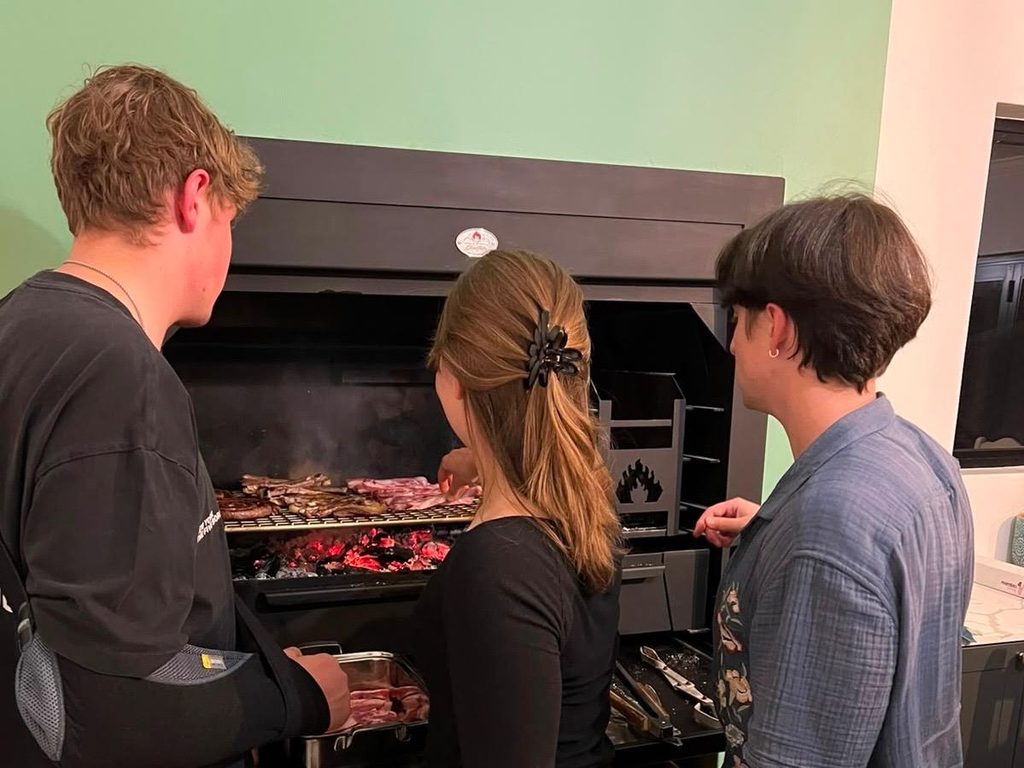
You can find braai rings everywhere, of all shapes and sizes, across South African households and public spaces: in game reserve campsites, by the beaches in KZN, backyards, indoor fireplaces, on the sidewalk.
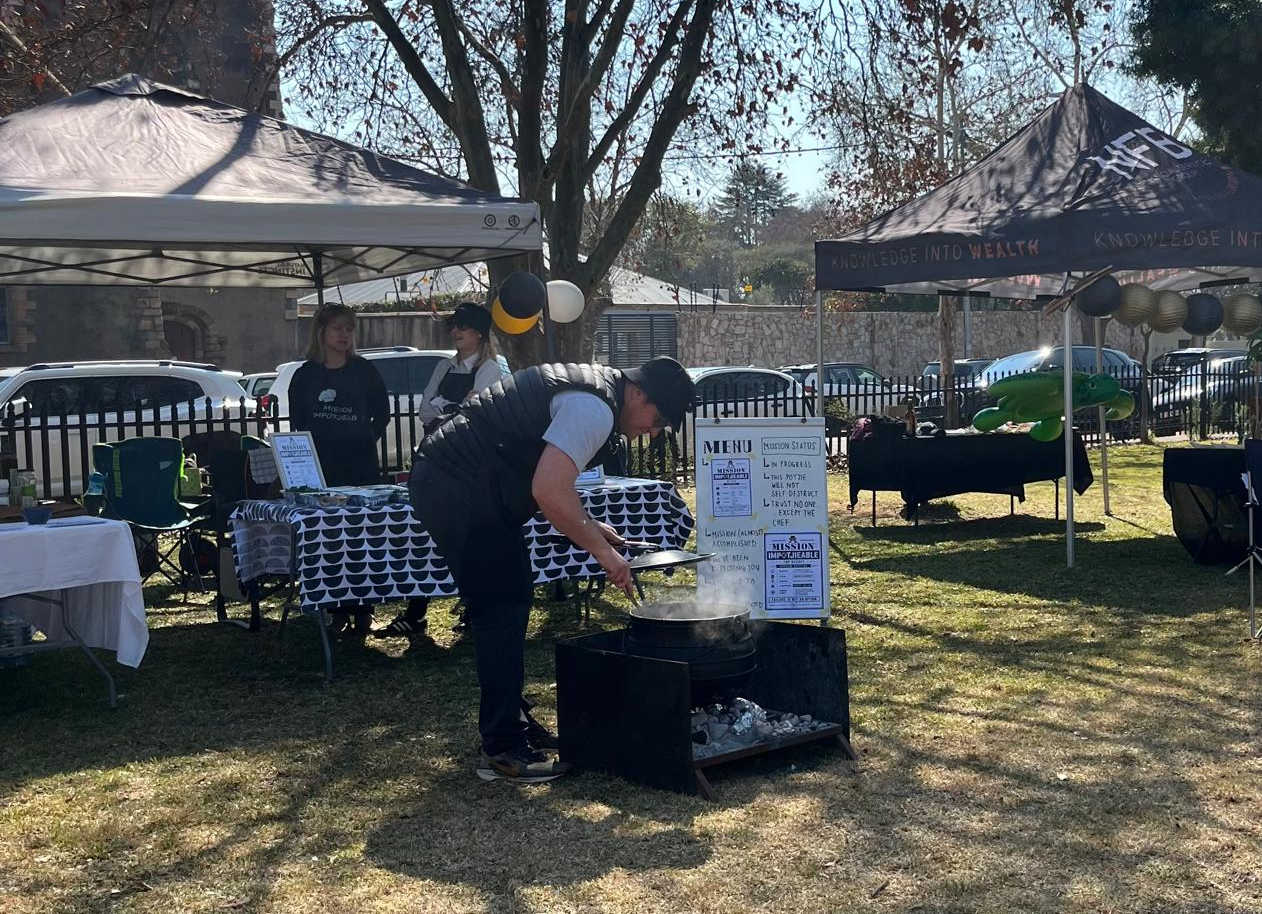
Another pan-South-African dish is potjie. Rather than a particular list of ingredients, potjie is a method of cooking delicious stews. Picture the witches of Macbeth’s cauldron bubbling for hours over a wood or coal fire. As a lover of everything made in a slow cooker, I can confirm that nothing but the sheer amount of time spent over the carefully tended flames can replicate a taste so rich and complex. The difference between potjie and my beloved Crock-Pot, however, is that I abandon my slow cooker at home while I’m busy studying and taking on too many projects at the same time. Cooking potjie over a fire means regular tending to it throughout cooking. I had the opportunity to try potjie at a church fundraiser one of my last weekends in South Africa. The labour of love to cook these massive cauldron meals was also a way for community to gather under the shade of park trees for a picnic. The cooks were teams of friends or coworkers who spent the day together at their tents, until all the food was eaten; and it was impressive how quickly it all disappeared.
If the way a country makes food is designed to spend time with loved ones, then it creates a common understanding and respect for personal time. Yes, we worked hard at LHR, but colleagues were incredibly respectful about time off and encouraged us to not stay at the office after working hours. We were almost shooed out of the office at 3pm on Fridays to go experience Joburg beyond our internship work.
Cooking, greeting, expecting at least one of your colleagues to arrive late to the meeting: these time-related practices make space and create the conditions necessary for finding balance and grounding in community. The hustle is omnipresent in South Africa – in the office, in markets, on the side of the street – but it doesn’t compare to the North American grind in which we get trapped by the expectation of living to work. I realize that this perception is shaped by the privileged positionality I held as a white Canadian working in a legal office. I can’t be certain the South African working class – or even fellow interns with roots in the Global South – would agree with my observations. Maybe my views remain voyeuristic, and it would take more time spent in the company of South African people to better understand and formulate my musings. I do hope to seize that time in the future. For now, I feel as though I left South Africa with as many teachings as my brain could hold before exploding. My New Semester resolution will be to hold onto these teachings as long as possible and strive to make my time feel personal, even if it means responding to emails with a few hours of days delay.